Getting to Koh Samui: Flights, Ferries and Bus-Ferry Combos Honestly Compared
Getting to Koh Samui: Flights, Ferries and Bus-Ferry Combos Honestly Compared
Koh Samui has no bridge and no causeway, and that single fact shapes everything about visiting it. Every person and every bag of rice arrives by air or by sea. The good news is that there are more ways to do it than most visitors realise — and the price difference between the proudest and the cheapest route can be five to one. This guide lays out every sensible option, what it really costs in money and hours, and which travellers each one suits.

Car ferry at Donsak Pier — Wikimedia Commons, Christophe95, CC BY-SA 4.0
Option 1: Fly Straight In — Bangkok Airways to Samui Airport
The simple way. Samui Airport (USM) is a privately owned airport, built and run by Bangkok Airways, and that airline operates the overwhelming majority of flights into it — mainly from Bangkok Suvarnabhumi, with additional routes from places like Chiang Mai, Phuket and Singapore depending on season. Other carriers appear on the schedule from time to time, but Bangkok Airways is the constant.
The airport itself is a delight — open-air, thatched roofs, more resort lobby than terminal — and it sits in the north-east of the island, minutes from Chaweng and Bophut. From wheels-down to beach can be under half an hour.

Koh Samui Airport runway 17, February 2024 — Wikimedia Commons, MNXANL, CC BY-SA 4.0
The catch is price. Because one airline controls the airport, fares from Bangkok rarely enjoy true budget competition; expect to pay a clear premium over mainland routes of the same distance, and for that premium to climb steeply in high season and around holidays. Booked well ahead for a quiet month, it's manageable. Booked late for New Year, it can sting.
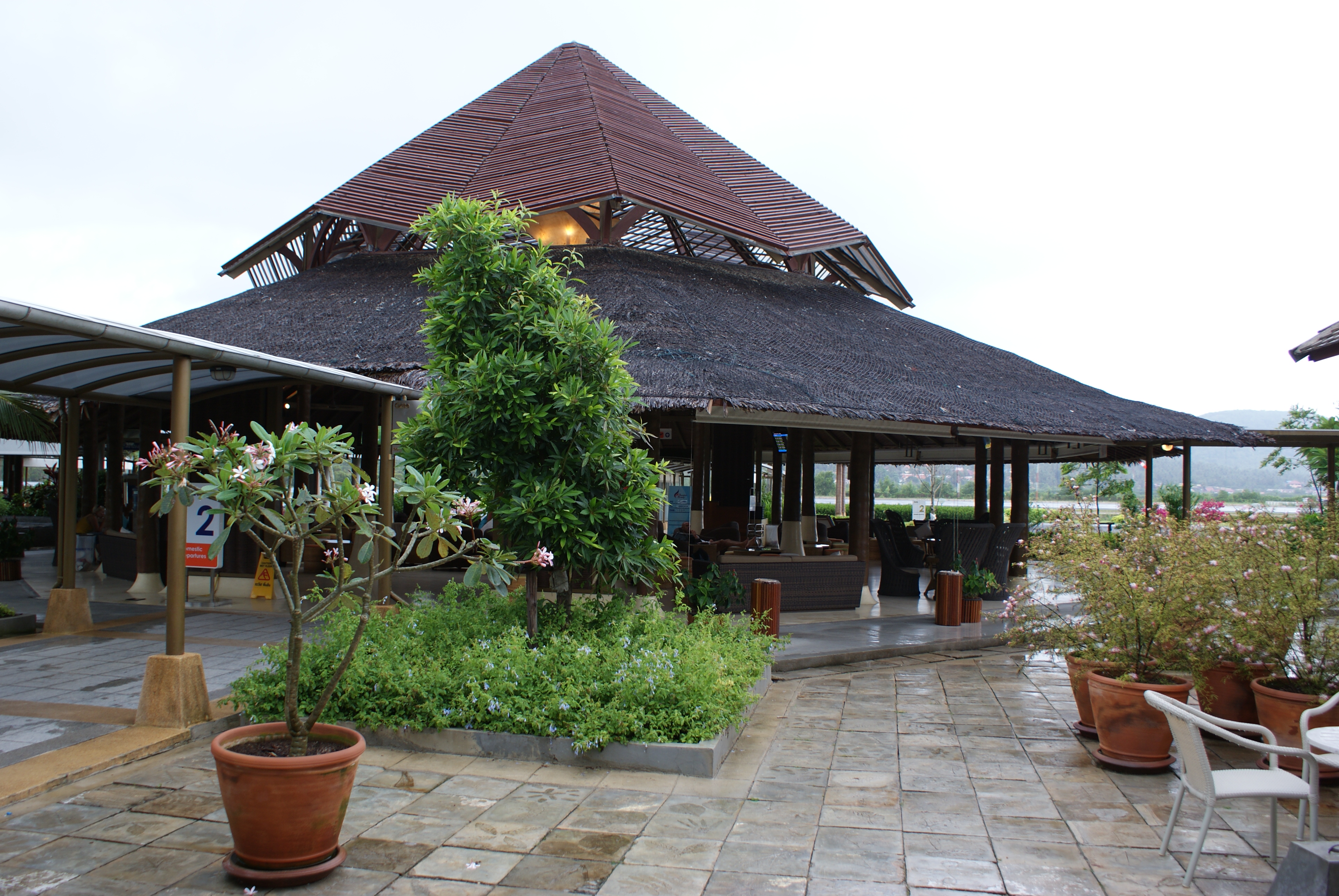
Samui Airport departure gate — Wikimedia Commons, Binderdonedat, CC BY 3.0 / GFDL
Suitability: short holidays, families with small children, anyone whose time is worth more than the fare difference. Around an hour in the air from Bangkok, plus airport time at both ends — call it 4 hours door to door from central Bangkok.
Option 2: Fly to Surat Thani or Nakhon Si Thammarat, Then Ferry
This is the route budget-savvy travellers and long-stayers actually use. The low-cost carriers fly from Bangkok (mostly Don Mueang) to Surat Thani airport for genuinely cheap fares, and from the airport, bus-and-ferry combo tickets take you straight through to Samui: bus to Donsak pier (about 1½ hours), then the ferry across (about 1½ hours on the big car ferries, faster on the catamarans from the same general area).
The combos are sold as single tickets by the ferry companies and transfer desks, and the system is well-worn — you will not be the first confused person holding a sticker and a bus voucher, and staff shepherd the whole flow. Nakhon Si Thammarat airport works the same way with a shorter bus ride for some sailings.

The ferry crossing — Ko Nok Taphao from a ferry — Wikimedia Commons, Christophe95, CC BY-SA 4.0
Realistic total: 6–8 hours door to door from Bangkok, at often a third to a half of the direct flight's cost. The sea crossing to Donsak is on big, stable car ferries (Seatran and Raja both run them) — cafeteria, open decks, and a proper sense of travelling to an island.
Suitability: long-stayers, backpackers, anyone flying with mainland-cheap luggage, and people who secretly enjoy ferries (we do). Less ideal with tight connections on the same day or very small children on a long travel day.
Option 3: Bus and Ferry from Bangkok — The Overnight Classic
The oldest route of all: an air-conditioned bus from Bangkok (Southern Bus Terminal, or the Khao San area services) down the highway to Surat Thani/Donsak, connecting with a morning ferry. Many services are sold as one through ticket, and the overnight version lets you sleep through the long road leg — such as it is on a bus seat — and wake up at the pier.
There's also the night ferry from Surat Thani town's pier: a slow boat that crosses overnight and arrives at Samui early in the morning. It's basic — mats and bunks, fans, a small shop — and beloved by travellers on the tightest budgets and by people who count a night boat as part of the adventure. It saves a night's accommodation, which is real math on a long trip.
Suitability: the budget end of the spectrum and slow travellers. Total journey 10–14 hours depending on connections. If a rough night's sleep ruins your next day, this isn't your route.
Option 4: Train to Surat Thani, Then Bus and Ferry
Thailand's southern railway runs from Bangkok to Surat Thani station (at Phunphin, about half an hour from the city), and from the station, buses meet the trains to run you to Donsak pier and the ferry. The sleeper trains are the civilised version: a proper berth, dinner in the dining car if you're feeling romantic, and a morning arrival.
It's not the fastest or even usually the cheapest door-to-door, but it's the most enjoyable way to cross the country if you have the time, and booking a lower berth in second class air-con is the classic move. Book ahead — sleepers sell out around Thai holidays.
Suitability: rail fans, slow travellers, and anyone coming from or via Hua Hin or Chumphon, where the train stops along the way.
Option 5: From Phuket and Krabi — Overland Plus Ferry
Since you'll find this site from our Phuket writing: Samui from Phuket is a cross-peninsula journey, not a boat ride. The standard route is bus or minivan across to Surat Thani/Donsak (roughly 4–5 hours of road) then the ferry — sold everywhere as a combo. There are also direct flights between Phuket and Samui in most seasons (back to Option 1 pricing logic), which at one hour in the air are very tempting for a short trip. From Krabi, the same overland-plus-ferry pattern applies with a shorter road leg. There is no direct public boat from Phuket or Krabi to Samui — anyone selling one is selling you a bus with extra steps.
And If You're Bringing a Car or a Full Life?
The Donsak–Samui car ferries are the island's umbilical cord: everything from scooters to cement mixers comes across on them. If you're relocating for a month or more, driving your own car over on the ferry (book the sailing; queues build at holidays) beats renting on the island. Even foot passengers should know the two Samui-side piers: the car ferries land at Lipa Noi (west coast) and Nathon area piers depending on company — check which one your ticket uses, because Samui is bigger than it looks and the wrong pier adds a 40-minute taxi ride at island taxi prices. The high-speed catamarans (Lomprayah and similar) use their own piers near Mae Nam/Bang Rak on the north coast, handy for Bophut, Mae Nam and Chaweng.
A Note on Times, Because Islands Run on Them
Every journey time in this article is a fair-weather, no-drama estimate — and Thailand travel being Thailand travel, you should treat the published timetables of ferries and combos as intentions rather than contracts. Boats wait for connecting buses; buses wait for late trains more often than you'd expect; the system is held together by people who've run it for decades and know which connections actually matter. The practical habits that protect you: screenshot your bookings, keep the combo operator's phone number, travel a day early for anything unmissable, and never — ever — book a same-day chain of three separate tickets with tight joins in monsoon season.
There's a compensating charm to all this. The Donsak crossing on a calm morning, coffee in hand, watching Samui grow out of the haze with the mainland shrinking behind, is one of the great arrivals in Thai travel — an hour and a half in which the holiday actually starts. The fly-direct route is quicker. It is not better in every way that counts.
Booking Tips and Traps We've Learned
Combo tickets are normal, and they work. The fly-bus-ferry and bus-ferry through-tickets sold by the airlines' partners, the ferry companies and station counters are an old, well-oiled system. Keep every stub and sticker until you're standing on Samui — the stickers are how staff route you.
Mind the last ferry. Ferries from Donsak stop in the early evening, and the last useful connection matters if your flight lands late at Surat Thani. A late flight that misses the last boat means an unplanned night in Surat Thani town — not a disaster (it's a pleasant, real Thai city with a famous night market) but annoying if unexpected. Check your combo's arrival against the sailing before you pay.
The airport premium applies to more than flights. Samui's private airport also means private-airport transfer pricing: official airport taxis and limousines cost more than mainland equivalents for short rides. Shared minivans to the main beaches are the reasonable middle option, and if you're staying a while, having your hotel or rental arrange pickup is often cheapest of all.
Luggage is rarely a problem. The big car ferries don't care about your bags; the catamarans handle them fine too. The only genuinely bag-hostile route is the night boat's open decks — keep valuables in a waterproof bag, as with any boat travel in Thailand.
Weather can rewrite the plan. In the rough weeks (usually around November–December), ferries can be delayed or cancelled and small catamarans suffer first. If you have a flight out of Bangkok the same day as a Samui sea crossing in monsoon season, you are braver than us. Pad the schedule.
Hopping Onward: Phangan, Tao and the Marine Park
Samui is also the transport hub for its neighbours. Fast boats run daily to Koh Phangan (30 minutes or so to Haad Rin or Thong Sala) and on to Koh Tao for the diving; the night boat and car ferries serve Phangan too. Ang Thong Marine Park — the archipelago of emerald islands you can see from Samui's west coast — is visited by day tours from Samui piers. If your trip includes the smaller islands, starting and ending in Samui gives you the widest choice of boats and the only airport — another reason the "which route in" decision matters less than people fear: you'll be on Samui boats all week anyway.
Which Pier, Which Beach: The Last-Mile Detail
Because it trips people up every day, one final piece of geography. If you arrive by car ferry from Donsak, you'll land on Samui's west coast (Lipa Noi or the Nathon piers, depending on operator) — perfect for the west and south, a 40–50 minute drive across or around the island to Chaweng. If you arrive by fast catamaran, you'll land on the north coast near Mae Nam/Bang Rak — handy for Bophut, Mae Nam and Chaweng, a longer haul to Lamai and the south. Samui Airport is in the north-east, closest to Chaweng, Choeng Mon and Bophut. None of these is a problem; all of them are worth knowing before you promise your hotel a check-in time or book a transfer blind. Taxis and shared vans meet every boat and flight, and on an island this size, even the "wrong" pier costs you time and money in tens of minutes and hundreds of baht, not hours and thousands. Arrive informed, then relax — you've reached the island, and the island is the point.
Our Honest Verdict
- Short break, money fine: fly direct. No contest.
- Month or more, budget matters: cheap flight to Surat Thani + ferry combo — the sweet spot of price versus pain.
- Rock-bottom budget / slow travel: overnight bus-ferry or the night boat, and treat it as part of the trip.
- From Phuket: fly if the fare is sane that week; bus-ferry if it isn't.
One last piece of hard-won advice: whatever route you choose, don't schedule anything important on Samui for the evening of your arrival day. Seas get rough, buses run late, and islands keep island time. Arrive, find the beach, and start tomorrow.
And a small confession to end on: after years of crossing every way there is, we still look forward to the ferry. The direct flight is a transaction; the slow route is a journey — mainland shrinking behind the stern, the island resolving out of the haze, the whole Gulf doing its morning glitter. If your schedule gives you the choice even once, spend it on the water. You'll arrive having already been somewhere.
About the Authors
We're Scott and Jay Riefler — we run a small, family-run condo business in Patong, Phuket, and travel Thailand the slow way whenever we can. More of our writing on living and travelling in Thailand lives at Patong-Thailand.com. This Samui site is where we keep our Gulf-side notes.


Comments
Post a Comment